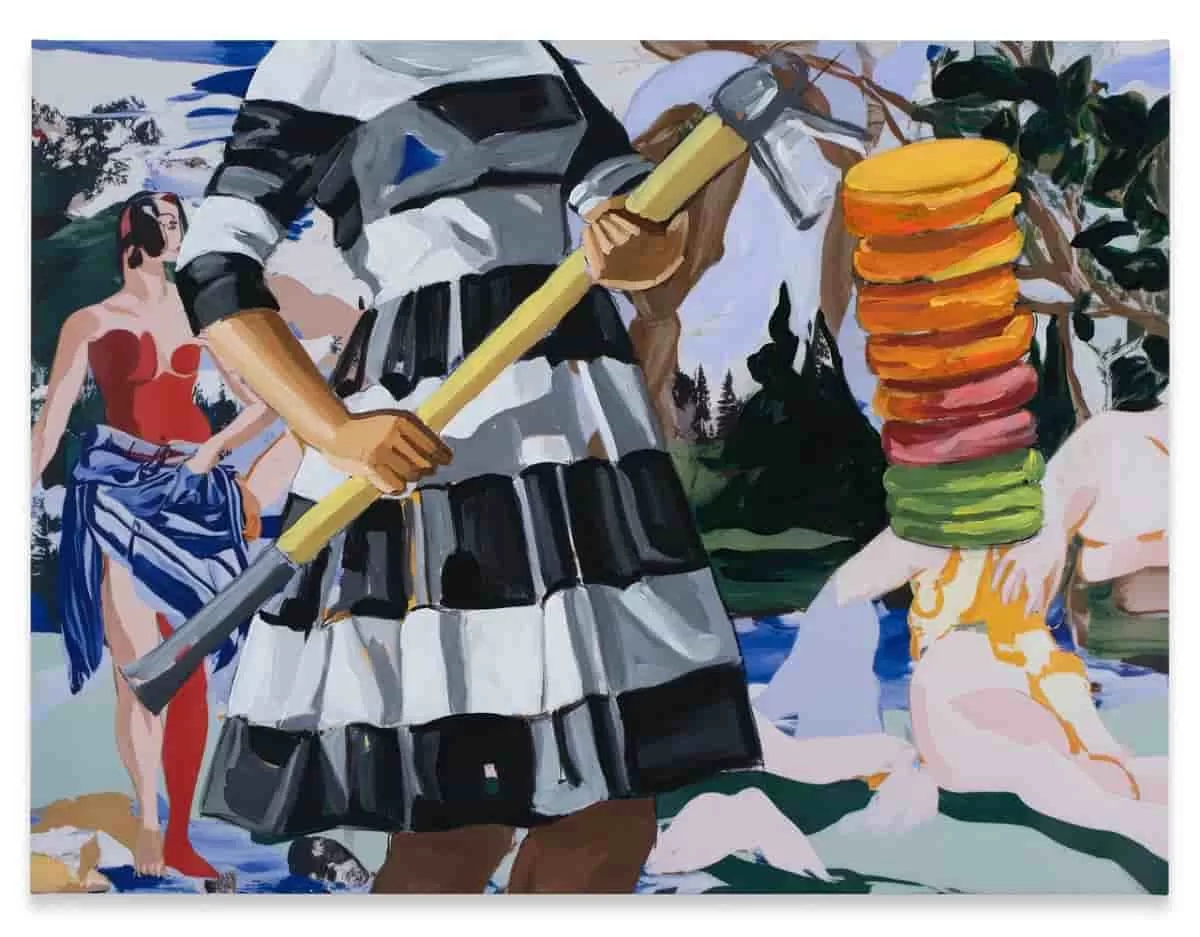
The Kelly Reemtsen lawsuit against David Salle involves allegations that David Salle’s ‘Hatchet’ painting copied protected elements from Reemtsen’s artwork.
The Kelly Reemtsen lawsuit against David Salle has placed a 2025 painting titled Hatchet at the center of a copyright dispute involving allegations of artistic copying and AI-assisted creation.
BY KAZEEM ADELEKE, ARTCENTRON
Kelly Reemtsen has filed a federal copyright infringement lawsuit against fellow artist David Salle, alleging that his painting Hatchet copied protected elements from two of her earlier works, Impact and It’s All Black and White. The complaint seeks damages, profits from the allegedly infringing work, and an injunction preventing the painting from being sold or exhibited.
Filed on June 22 in the U.S. District Court for the Central District of California, the lawsuit also asks the court to order that Hatchet either be transferred to Reemtsen or destroyed if the court finds that copyright infringement occurred.
Kelly Reemtsen Lawsuit Against David Salle: What the Copyright Case Claims
According to the complaint, Reemtsen argues that Hatchet reproduces several protected elements from her paintings Impact and It’s All Black and White. She alleges that the similarities extend beyond general ideas. She contends that it also includes the figure’s pose, perspective, clothing, composition, and overall visual impression.
Although the paintings are not identical, the complaint contends that the cumulative similarities create an overall appearance that is substantially similar to her original works. The lawsuit asks the court to determine whether those similarities amount to copyright infringement under federal law.
In addition to seeking financial compensation, Reemtsen is requesting an injunction to prevent future sales or public exhibition of Hatchet. The complaint also seeks recovery of any profits connected to the painting. Additionally, there is a request that the artwork be turned over to her or destroyed if infringement is established.
David Salle’s ‘Hatchet’ Painting and the AI-Assisted Creative Process
The disputed painting was first exhibited in My Frankenstein, a solo exhibition at Sprüth Magers Los Angeles. The show opened in February 2025.
David Salle used artificial intelligence as part of his creative process for Hatchet, drawing additional attention to the painting. Salle has previously described working with an engineer to develop a generative AI model trained exclusively on selections from his own body of work. The system generates new visual arrangements that he refines into completed paintings.
While the lawsuit does not challenge the AI technology itself, the use of AI-assisted creative tools has become part of the broader discussion surrounding the case and the evolving relationship between technology and artistic authorship.
How the Copyright Dispute Sparked Debate in the Art World
Questions surrounding Hatchet emerged shortly after the painting went on public display. Social media users compared the work with Reemtsen’s Impact. They prompted widespread online discussion about whether the similarities represented artistic influence, appropriation, or unlawful copying.
The debate also drew attention to Salle’s long-established artistic practice. Through Sprüth Magers, his representatives have described borrowing imagery from sources. They include popular culture, advertising, photography, art history, and his own archive as a defining feature of his work. They also noted that other artists have referenced Salle’s paintings over the years.
Salle is widely recognized as a leading figure of the Pictures Generation. This is a movement of American artists that emerged during the late 1970s and early 1980s. Artists associated with the movement frequently explored originality, authorship, and image reuse by incorporating existing visual references into new works.
Why the Case Could Have Broader Implications
The lawsuit arrives at a time when copyright law is increasingly intersecting with advances in artificial intelligence. Courts, artists, and legal experts continue to examine how existing intellectual property laws apply to AI-assisted creative practices and what constitutes original artistic expression.
Although the complaint focuses on the finished painting rather than the AI model used during its creation, the case may contribute to ongoing discussions about originality, creative ownership, and the legal boundaries of artistic borrowing.
Artists, galleries, collectors, and legal professionals will likely follow the case closely. Similar copyright disputes continue to emerge across the contemporary art world.
What Happens Next in the Kelly Reemtsen Lawsuit?
The federal court will now review the allegations presented in Reemtsen’s complaint before the case proceeds through the litigation process. David Salle will have an opportunity to respond to the claims. Thereafter, the court will determine how the case moves forward.
As the litigation progresses, artists, galleries, and legal observers will likely continue monitoring the case. This is because it combines questions of copyright protection, artistic appropriation, and AI-assisted creativity. The court’s eventual decision may offer additional guidance on how copyright law applies. More importantly, it will determine when traditional artistic practices intersect with emerging technologies.