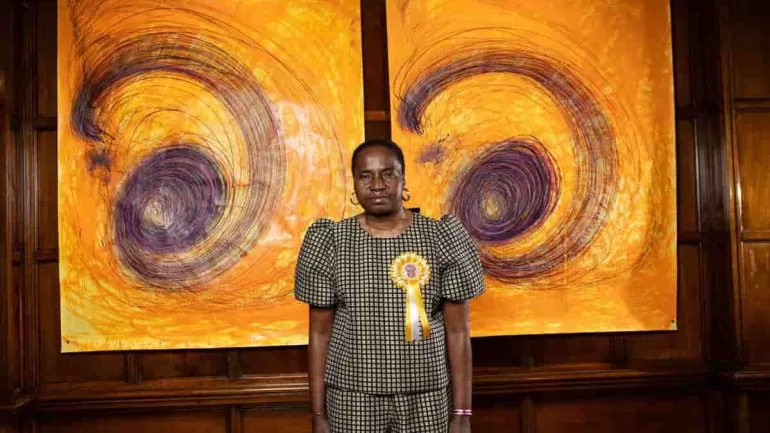
The Turner Prize winner, Nnena Kalu, is the first learning-disabled artist to win the coveted award. Her powerful, tactile, colorful abstract sculpture was the key to her success.
BY KAZEEM ADELEKE, ARTCENTRON
Nnena Kalu has won theTurner Prize 2025, a landmark achievement that positions her at the forefront of Britain’s contemporary art scene. She receives the £25,000 award, while fellow shortlisted artists Mohammed Sami, Rene Matić, and Zadie Xa each take home £10,000.
Her win is historic and transformative. Kalu is the first learning-disabled artist to receive the Turner Prize, breaking a barrier that has long defined the U.K. art world. Tate Britain director Alex Farquharson said the victory “begins to erase that border between the neurotypical and neurodiverse artist,” highlighting its cultural significance.
A Distinct Visual Language: Gesture, Rhythm, and Movement
Born in Glasgow in 1966, Kalu has developed a unique, wordless artistic vocabulary shaped by autism and limited verbal communication. She has honed her practice with ActionSpace since 1999, exploring repetition, layering, and bodily movement as central components of her work.
Her sculptures use repurposed materials, including VHS tape, flexible ducting, rope, fabric, and clingfilm. They are twisted, wrapped, and bound into large cocoon-like forms. The award-winning installation, Hanging Sculpture 1 to 10 (2024), suspends these vibrant bundles, creating a constellation of shapes that feel both organic and otherworldly.
Critics praise the intensity and physicality of her work. Adrian Searle described her practice as “irreducible,” noting how every sculpture emerges from the body outward. Kalu’s vortex drawings, made with spiraling pen and pastel lines, similarly record movement, breath, and gesture on a human scale.
The Turner Prize 2025 Exhibition in Bradford
The Turner Prize 2025 announcement took place in Bradford, with the accompanying exhibition open at Cartwright Hall Art Gallery. The exhibition continues through February 22, 2026.
This year’s shortlist showcased a broad spectrum of voices. Rene Matić presented intimate photography and installations rooted in family and identity. Mohammed Sami explored trauma and memory through large-scale paintings. Zadie Xa offered an immersive installation inspired by Korean folklore and diasporic identity.
Though early speculation favored Sami, Kalu’s work ultimately commanded the jury’s attention. The decisive factor was not simply scale or color; it was the visceral, embodied presence of the sculptures. The sense of material and movement emerging directly from the artist’s body gives the work credence.
Reframing a Controversial Prize
Founded in 1984, the Turner Prize stands as Britain’s leading art award. It honors one artist each year, either British or based mainly in the U.K.
The Turner Prize has long had a turbulent reputation. Its 1990s notoriety was fueled by the Young British Artists, including Damien Hirst, who shocked audiences with Mother and Child, Divided. There is also Tracey Emin, whose My Bed challenged conventional notions of art.
In recent years, critics questioned the prize’s relevance. Kalu’s win reaffirms the award’s purpose: to recognize artists who push boundaries and reimagine creative practice. Her achievement demonstrates that dedication to material, gesture, and sustained experimentation defines artistic excellence.
A Landmark Achievement in Contemporary Art
The 2025 jury’s decision situates Kalu among past luminaries such as Rachel Whiteread, the first woman to win; Chris Ofili, the first Black winner; and Wolfgang Tillmans, the first non-British recipient. Other transformative figures include Damien Hirst, Grayson Perry, and Lubaina Himid.
The Nnena Kalu Turner Prize win marks a turning point for the visibility of learning-disabled artists. It expands the boundaries of contemporary art. Her sculptures, built through gesture and repetition, demand that viewers engage with material and movement in new ways. Kalu’s victory is not only a personal achievement—it is a milestone for the art world. The achievement signals a broader understanding of creativity, inclusion, and expression.
- Featured Image: Nnena Kalu, winner of the Turner Prize 2025, in front of one of her paintings. Photo by James Speakman