ART & DESIGN
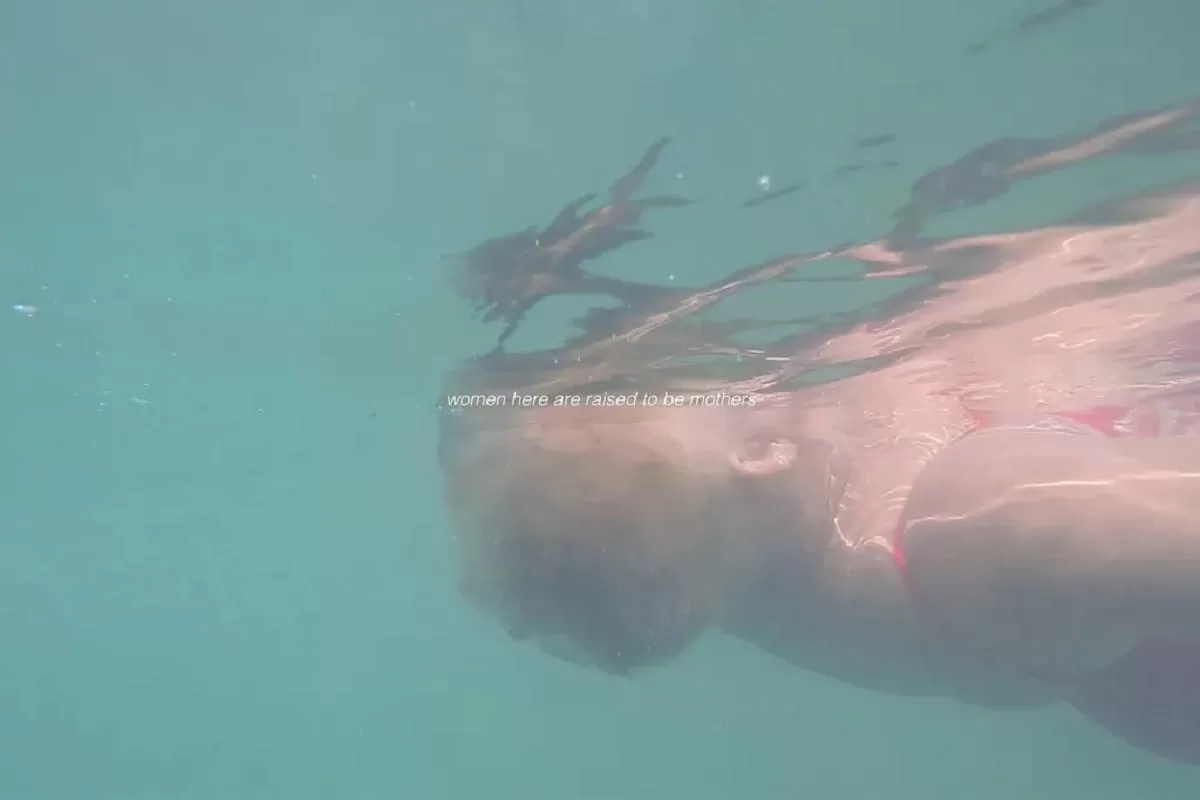
In Retiro (2019), Natalia Lassalle-Morillo uses the fluid movement of a swimming woman to challenge the rigid structures of hydro-politics and borders. The text overlay reminds us how identity and gender are shaped by the environments we inhabit. Image courtesy of the artist.
Can a river be a fence? Humid Traces explores hydro-politics and borders, revealing how states use shifting water to control movement and migration.
BY KAZEEM ADELEKE, ARTCENTRON
In an era where the climate crisis is redrawing the map, the traditional concept of sovereignty is dissolving into the sea. Hydro-politics and borders are no longer static lines on a page but fluid, contested zones where states increasingly weaponize water to enforce control. This tension takes center stage in ‘Humid Traces‘ at the Ford Foundation Gallery, a compelling exhibition that uncovers how water—once considered a shared life force—has become a tactical tool for modern geopolitical division
Hydro-politics and borders are being radically redefined as climate change turns the world’s waterways into sites of political conflict. At the Ford Foundation Gallery, the exhibition Humid Traces examines this shift. It moves beyond the idea of water as a simple resource to reveal it as a sophisticated tool of state power. Curated by Federico Pérez Villoro, the show argues that rivers and glaciers are not just natural features. Instead, they are the physical infrastructure through which national boundaries are engineered, enforced, and destabilized.
Hydro-Politics and Borders: The Conflict Between Flow and Fences
A fundamental contradiction lies at the heart of modern geography. Rivers are shifting, living entities, yet governments insist on treating them as static political lines. As the climate crisis accelerates, states have turned this environmental instability into a strategy for control. Rather than adapting to the changing landscape, border regimes often exploit the dangers of unpredictable currents. This effectively weaponizes the environment to discourage human movement.
Cartographies of Loss and Erasure
The artists in Humid Traces challenge official government maps by documenting the physical reality of disappearing landscapes. For example, the collective Archivo Familiar del Río Colorado presents an “archaeology of absence.” They use archival debris and satellite imagery to show how water extraction has erased the Colorado River Delta at the US–Mexico border. While the political boundary remains on paper, the life-sustaining river has vanished.
Migration and the Shifting Ground
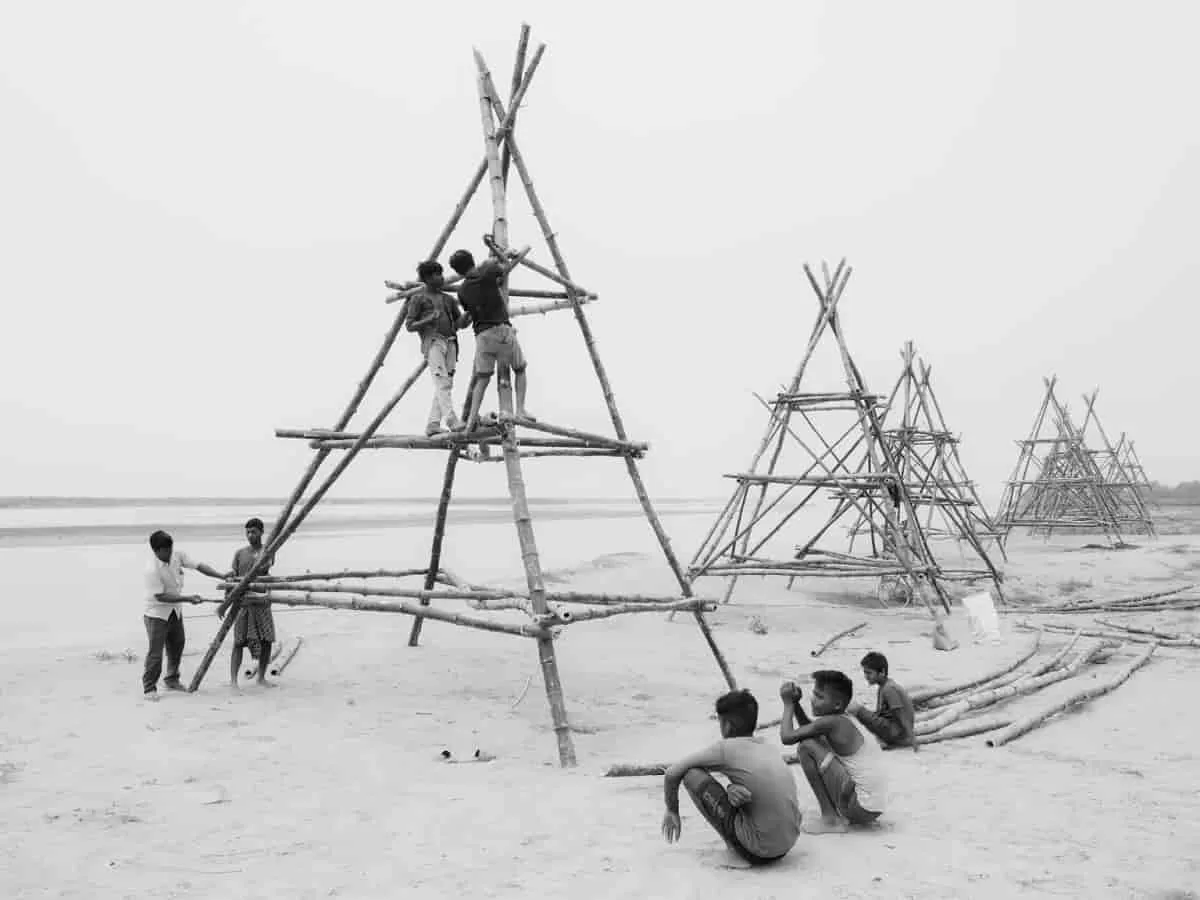
In many regions, citizenship is tied directly to the stability of the soil. Photographer Zishaan A. Latif captures the Miya people along India’s Brahmaputra River. Here, constant erosion reconfigures the land every year. His work exposes a cruel bureaucratic trap. The river washes away the physical ground, yet the state still demands proof of “permanent residence.” Similarly, Caio Reisewitz documents how the Belo Monte hydroelectric dam acts as a colonial device. His photographs show how massive infrastructure reshapes the Amazon while displacing Indigenous communities.
When Sovereign Borders Start to Drift
The exhibition also undermines the authority of national maps by showing how nature ignores human law. The project Italian Limes used GPS sensors to track Alpine glaciers. It revealed a startling reality: as the ice melts, the physical watershed defining the border between Italy and Austria is actually drifting. This proves that national sovereignty is contingent on a changing climate. Furthermore, Susan Schuppli’s film Moving Ice reveals the long history of the “frozen water trade.” She shows how colonial powers have treated cold temperatures as a financial commodity for centuries.
Memory as a Tool of Resistance
Against these cold, systemic forces, some artists offer a more intimate form of witness. Marisa Srijunpleang explores the Thai–Cambodian border to find the traces of her grandparents’ home. She uses “crown flower” seeds to create fragile sculptures. By turning organic matter into a memory device, she shows that identity survives even when the state tries to erase it. Natalia Lassalle-Morillo further explores this in Retiro. She frames Puerto Rican identity as a fluid movement between islands rather than a fixed point on a map.
The Future of Hydro-politics and Borders
Humid Traces avoids the typical rhetoric of environmental “preservation.” Instead, it reveals water as a force that disrupts political logic. We often treat the climate crisis as a technical problem to be managed. However, this exhibition offers a more sobering truth. Water cannot be fully contained or stabilized. Ultimately, the show leaves us with a vision of hydro-politics and borders as provisional constructions. They are constantly being washed away by the very waters they try to claim.
As climate change redraws our maps, do you think our current definition of ‘borders’ can survive a warming world? Let’s discuss in the comments.
