ENTERTAINMENT
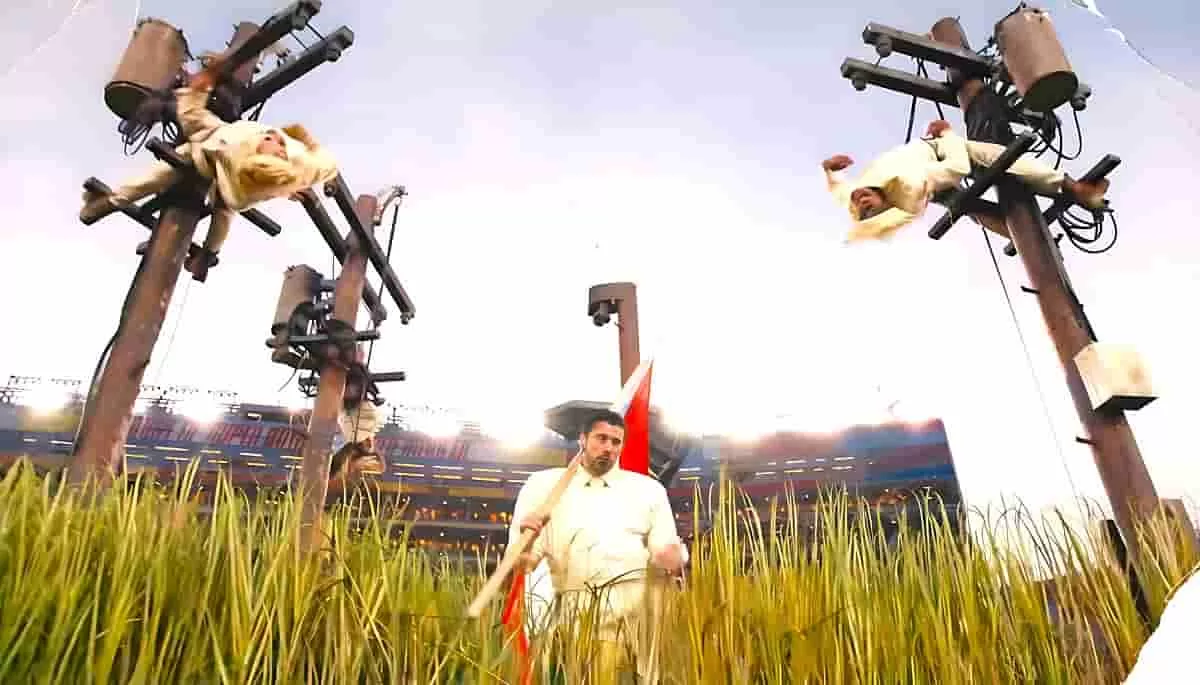
A scene from the Bad Bunny Super Bowl halftime show that functions as installation art, directly referencing Puerto Rico’s ongoing struggles with power infrastructure. Screen Grab
Bad Bunny Super Bowl halftime show set was more than music—it was a pop art installation. Here is how he used Spanish and site-specific staging to redefine the stage.
BY PHILIP TRENTON, ARTCENTRON
The Super Bowl has long transcended football to become a massive cultural monolith. Yet, while most performers aim for broad consensus, the Bad Bunny Super Bowl halftime show took a radical detour, turning the world’s most-watched stage into a moment of genuine performance art. As the game faded and the commercials blurred into the background, his set remained—vibrant, urgent, and unapologetically specific.
Beyond the “Safe” Pop Medley
Most halftime shows function as a safe “greatest hits” reel, designed to provide background noise for a party. Bad Bunny, however, treated the stage as a site-specific installation. By weaving together movement, sound, and color into an immersive experience, he bypassed the traditional “pop medley” format.
Critically, he did not slow down to guide or explain the performance to a general audience. Instead, he exhibited the confidence of a fine artist, trusting the viewer to experience the work in real-time without a roadmap.
Language as an Architectural Pillar
Perhaps the most subversive element was the linguistic choice. By performing almost entirely in Spanish—without translation or “softening” for a domestic broadcast—Bad Bunny challenged the assumption that the Super Bowl must speak in a singular cultural voice.
In the world of performance art, the viewer is expected to adapt to the work, not the other way around. By refusing to bridge the gap for the audience, the performance forced a massive, diverse viewership to meet him on his own terms, effectively reframing the Super Bowl as a space for cultural visibility rather than assimilation.
Bad Bunny Super Bowl Halftime Show: The Power of Friction
The Super Bowl usually thrives on comfort, often stripping an event of its edges to ensure mass appeal, but Bad Bunny disrupted this pattern. By prioritizing immersion over narrative, the staging focused on raw rhythm and atmosphere rather than a linear story. Cultural references appeared not as “Easter eggs” waiting to be decoded, but as lived realities—absolute facts of the performance. This approach polarized viewers, and that friction proved its success; in a digital landscape where agreement rarely signals true influence, the “split” reaction to the set was the ultimate validation. The show generated a lasting cultural conversation specifically because it refused to be neutral.
In a digital landscape where agreement rarely signals true influence, the “split” reaction to the set was the ultimate validation. The show generated a lasting cultural conversation specifically because it refused to be neutral.
Art vs. Nostalgia
Recent halftime shows have leaned heavily on nostalgia, delivering the comfort of recognition rather than the spark of urgency. Bad Bunny offered a different path, proving that a massive pop platform can still function as a cultural intervention.
By the following morning, the conversation wasn’t about the final score or the ads; it was a debate on language, identity, and the boundaries of public art. Bad Bunny didn’t “save” the Super Bowl by playing by the rules—he saved it by treating a $500 million broadcast as a blank canvas, reminding us what risk looks like when art steps into the light.
