ART NEWS
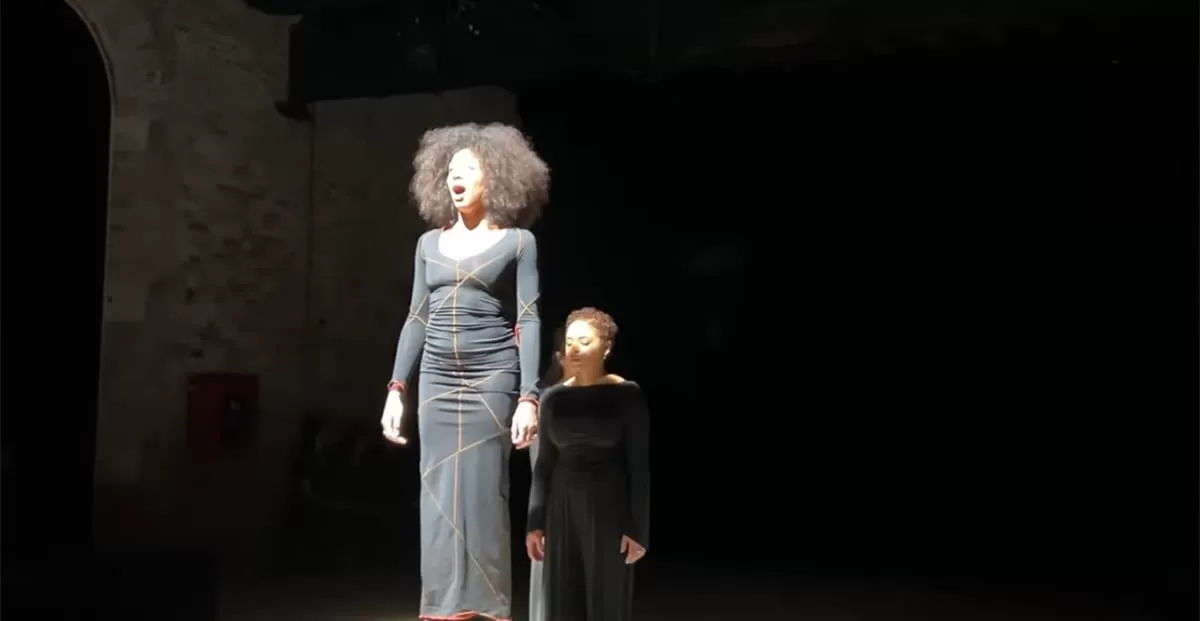
Gabrielle Goliath on stage performing Elegy. The South Africa Venice Biennale pavilion cancellation followed a dispute over a proposed artwork acquisition and claims of political interference.
The South Africa Venice Biennale pavilion cancellation involved interest from Qatar Museums, not the Qatari state, clarifying earlier reports.
BY KAZEEM ADELEKE
VENICE / JOHANNESBURG — South Africa’s Venice Biennale pavilion cancellation stemmed from a dispute over a proposed artwork acquisition, not from the exhibition’s political content, according to new reporting by the Daily Maverick.
The clarification follows earlier reporting on the abrupt withdrawal of artist Gabrielle Goliath’s pavilion, which sparked accusations of art censorship tied to the Gaza conflict and her performance Elegy. Artcentron previously reported on the controversy surrounding the cancellation in its coverage of the South Africa Venice Biennale censorship controversy.
Culture Minister Gayton McKenzie previously said he canceled South Africa’s official pavilion at the Venice Biennale after a foreign entity attempted to purchase the work scheduled for display at the end of the exhibition. He denied that the decision was influenced by the subject matter of the artwork.
That account conflicted with earlier reporting by the Daily Maverick, which stated McKenzie had privately described the pavilion as “polarizing.” The remarks also fueled international speculation after an Israeli media outlet published unverified claims identifying Qatar as the country involved.
According to the Daily Maverick, those claims were inaccurate. The interest came from Qatar Museums, a state-run cultural institution, rather than from the Qatari government itself. The organization expressed interest in acquiring a video recording of Elegy, the performance selected for South Africa’s national presentation.
Artwork Acquisition at the Center of Dispute
Elegy addresses the killing of women and queer people in South Africa and references the genocide committed in Namibia under German colonial rule. The work was set to anchor South Africa’s national pavilion at the Biennale.
Goliath told the Daily Maverick that acquisition discussions are standard practice at international exhibitions. National pavilions often rely on private individuals and cultural institutions, many of which later acquire works shown during the event.
“The minister’s narrative reflects a misunderstanding of the arts economy and how Biennale pavilions function,” Goliath said.
Qatar Museums Responds
In correspondence cited by the publication, Qatar Museums said it would be “happy to share it with our Art Mill curator for their interest.” The Art Mill museum project is a major institution under development in a former industrial flour mill.
The South Africa Venice Biennale pavilion cancellation has sparked debate over artistic freedom and political oversight. Critics are also questioning how the South Africa Department of Sport, Arts and Culture manages the country’s international cultural representation. Officials have not said whether the pavilion will be reinstated or replaced during the current Biennale cycle.
