ART
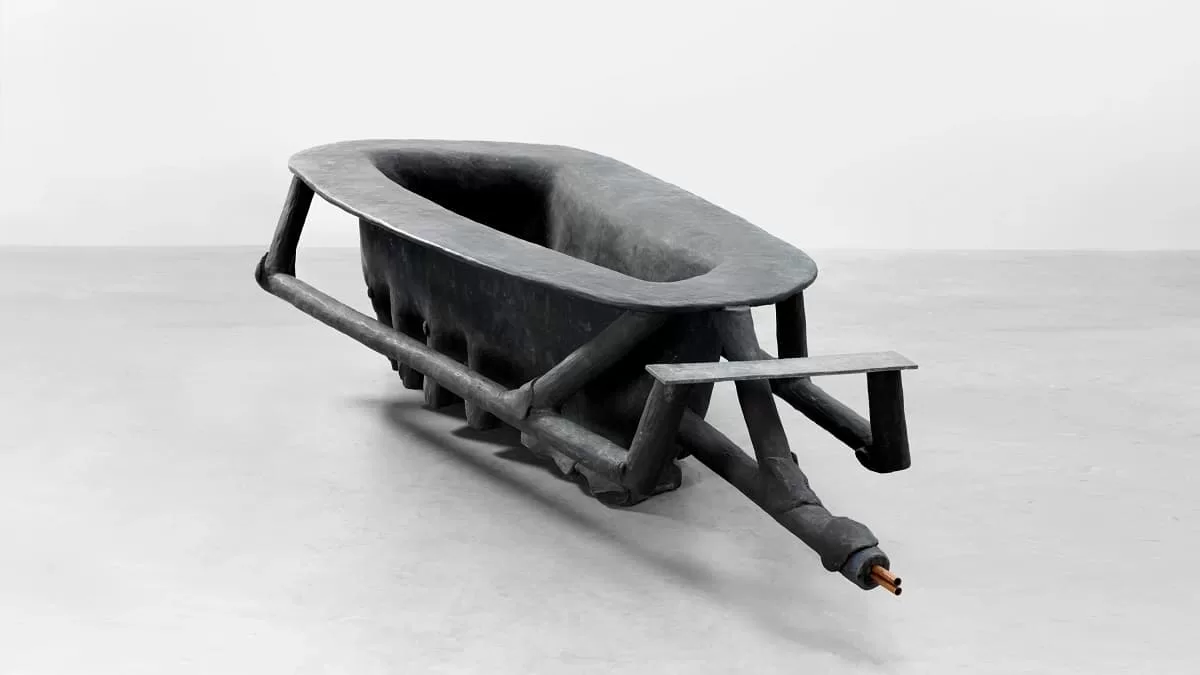
Joseph Beuys: Bathtub for a Heroine brings his iconic “organic machines” to London, revealing his vision of the heroine as a catalyst for change.
BY KAZEEM ADELEKE, ARTCENTRON
Walking into Thaddaeus Ropac London, one is immediately struck by the strange, conductive silence of bronze, bone, and fat. Joseph Beuys, the titan of postwar German art, famously sought to dismantle the boundaries between art, science, and social theory. In this focused exhibition, we are given a rare look at the decades-long evolution of his most enigmatic motifs. The show reminds us that Beuys never just made objects—he built batteries for the soul.
Joseph Beuys: Bathtub for a Heroine—The Alchemy of Warmth
One of the most compelling aspects of the exhibition is its exploration of “evolutionary warmth.” For Beuys, warmth was more than a physical sensation. He viewed it as a dynamic force capable of softening rigid material and mental structures. In a post-war society he viewed as “cold,” repressed, and “burnt-out,” warmth was a prerequisite for any meaningful change.
This concept is embodied in the central work, Bathtub for a Heroine (1961–87). The sculpture is a fascinating hybrid of the prehistoric and the industrial. The work combines the heavy permanence of bronze with the urgent utility of immersion heaters. It also incorporates evocative organic matter, such as mammoth teeth. By creating these “organic machines,” Beuys suggests that the object is not a static relic but a conductive medium. The bronze doesn’t just sit there; it implies the capacity to hold and transfer heat, echoing his “Social Sculpture” theory. It exudes Beuys’ idea that every individual possesses the potential to participate in the warming and reshaping of the political body.
The Feminine as the Catalyst
The exhibition’s title highlights a recurring theme that feels strikingly modern: the Heroine. Beuys frequently positioned the female figure as the primary agent of transformation. To Beuys, the “masculine” intellect of the era had become crystallized and stagnant—a “clinker” in the furnace of history. In contrast, he viewed the “feminine” as fluid, a force capable of traversing social, temporal, and geological realms.
In the context of the gallery, the bathtub becomes more than a vessel; it is a site of transition and birth. The female figures in his accompanying drawings are not passive subjects; they are resilient forces of nature. Whether depicted in a state of levitation or bound by industrial clamps, they embody the spiritual conductivity required to challenge rigid systems. They are the “heaters” in the bathtub of a cold civilization.
A Legacy of Healing: The Open Question
As the exhibition demonstrates, Beuys’ work remains strikingly relevant. However, it poses a difficult question: Can a sculpture truly act as a catalyst for collective healing in 2026? In our current era of digital “coldness” and social fragmentation, Beuys’ reliance on physical, evolutionary warmth feels like a radical hope. At the same time, it feels like a distant myth.
Joseph Beuys: Bathtub for a Heroine is a poignant reminder that the act of creation has the power to reshape the world. This transformation can happen through bronze, dialogue, or social action. Ultimately, the work leaves the viewer wondering if we still have the courage to provide the “warmth” necessary to melt the rigidities of our own time.
