ART

Shin Min Art Installation in Booth P21 at the Art Basel Hong Kong. She won the inaugural MGM Discoveries Art Prize BNM. Image: Art Basel Hong Kong
Art Basel Hong Kong connects global galleries, collectors, and artists, positioning Asia at the center of the contemporary art world.
BY KAZEEM ADELEKE, ARTCENTRON
Art Basel Hong Kong stands as the most influential art business platform in Asia. It shapes the global contemporary art market through its scale, capital concentration, and cultural leadership. As the region’s premier international art fair, it connects leading galleries, collectors, and institutions while reinforcing Hong Kong’s role as a strategic bridge between Eastern creativity and Western markets. With its expanding Asia-Pacific focus, strong institutional presence, and growing influence on market trends, the fair has become a key barometer of the global art economy’s health.
Art Basel Hong Kong: Evolution of Asia’s Art Business Ecosystem
Art Basel Hong Kong has evolved far beyond its origins as a regional trade event. It now operates as a high-stakes platform crucial to the contemporary art market in Asia. Since its inception, Art Basel Hong Kong has been a critical conduit for the Swiss Art Basel brand’s global expansion. At the same time, it has anchored the maturation of Asia’s cultural economy. Its sustained success reflects both the rise of the Asian art market and the growing influence of Asian art collectors and global capital in contemporary art.
Located in one of the world’s most advanced financial centers, Art Basel Hong Kong facilitates a distinctive convergence of Eastern creative production and international investment. This positioning has helped Hong Kong emerge as an indispensable art business hub. Logistical efficiency in the city supports cultural exchange and enables long-term market development.
Art Basel Hong Kong 2025: A Benchmark for the Global Art Market.
The 2025 edition of Art Basel Hong Kong, held at the Hong Kong Convention and Exhibition Centre, offered a definitive benchmark for the health of the global art fair ecosystem. The fair featured 240 galleries from 42 countries and territories and attracted approximately 91,000 visitors. These visitors included high-net-worth collectors, advisors, and institutional patrons from over 70 nations, reinforcing the fair’s global reach.
The fair’s international footprint underscored its enduring ability to connect the global art market with Asia’s expanding collector base. Against the backdrop of shifting market dynamics, Art Basel Hong Kong demonstrated commercial resilience. It also reflected sustained confidence among galleries operating across both primary and secondary markets.
Strengthening Asia-Pacific Representation in Contemporary Art
A defining strength of Art Basel Hong Kong lies in its structural commitment to regional representation. More than half of the participating exhibitors originated from the Asia-Pacific region. As a result, the fair functioned as a vital platform for contemporary Asian artists and galleries. This balance allowed Art Basel Hong Kong to operate simultaneously as a gateway for Western blue-chip galleries and as a powerful amplifier for Asia’s most influential contemporary voices.
By strengthening visibility for regional practices within a global framework, Art Basel Hong Kong continues to reshape perceptions of the contemporary art market in Asia. It affirms the region not as a peripheral market, but as a central driver of artistic production, institutional attention, and collector demand.
Art Basel Hong Kong : Intersection of Art, Technology, and Finance
Beyond its commercial role, Art Basel Hong Kong has cultivated a sophisticated ecosystem of programming. This approach addresses the evolving relationship between art, technology, and finance. Initiatives such as Digital Dialogues at the 2025 edition explored the implications of new media, artificial intelligence, and digital infrastructure. These programs examined how such developments affect authorship, provenance, and market valuation.
Through these discussions, Art Basel Hong Kong positioned itself as a leading forum for examining how digital art and market innovation are reshaping contemporary art commerce. By engaging directly with emerging technologies, the fair reinforced its relevance for collectors, institutions, and galleries navigating a rapidly transforming global art economy.
Institutional Validation and Cultural Diplomacy in Asia
Participation from leaders affiliated with the Museum of Modern Art in New York, the Mori Art Museum in Tokyo, and Hong Kong’s M+ provided essential institutional validation. This endorsement remains critical for long-term value formation in the contemporary art market.
These institutional exchanges elevate Art Basel Hong Kong beyond a transactional marketplace. They position the fair as a site of cultural diplomacy and intellectual leadership, where curatorial discourse intersects with market strategy. This role strengthens Hong Kong’s standing within the broader network of global cultural capitals.
Economic Impact and the Expansion of Hong Kong Art Week
The economic resilience of Art Basel Hong Kong 2025 was evident in strong sales across diverse price points. Transactions ranged from emerging contemporary works to high-value secondary-market masterpieces. This success extended beyond the fair itself, generating a broader Hong Kong Art Week effect that activated galleries, auction houses, museums, and nonprofit spaces across the city.
This synergy reinforces Hong Kong’s position as the primary bridge between East and West within the global art business. The concentration of exhibitions, auctions, and institutional programming during the fair period sustained a vibrant cultural economy. This momentum continued to benefit Hong Kong throughout the year.
Why Art Basel Hong Kong Remains Central to the Global Art Narrative
As the global art landscape continues to evolve, Art Basel Hong Kong remains a critical barometer for collector sentiment, institutional priorities, and market trends. By supporting both the business operations of galleries and rigorous engagement with modern art ideas, the fair underscores Asia’s central role in today’s art ecosystem.
Ultimately, Art Basel Hong Kong stands not only as a reflection of current market strength. It also operates as a transformative force that redefines how contemporary art is produced, circulated, collected, and valued on a global scale.
Market Snapshot: ABHK 2025 at a Glance
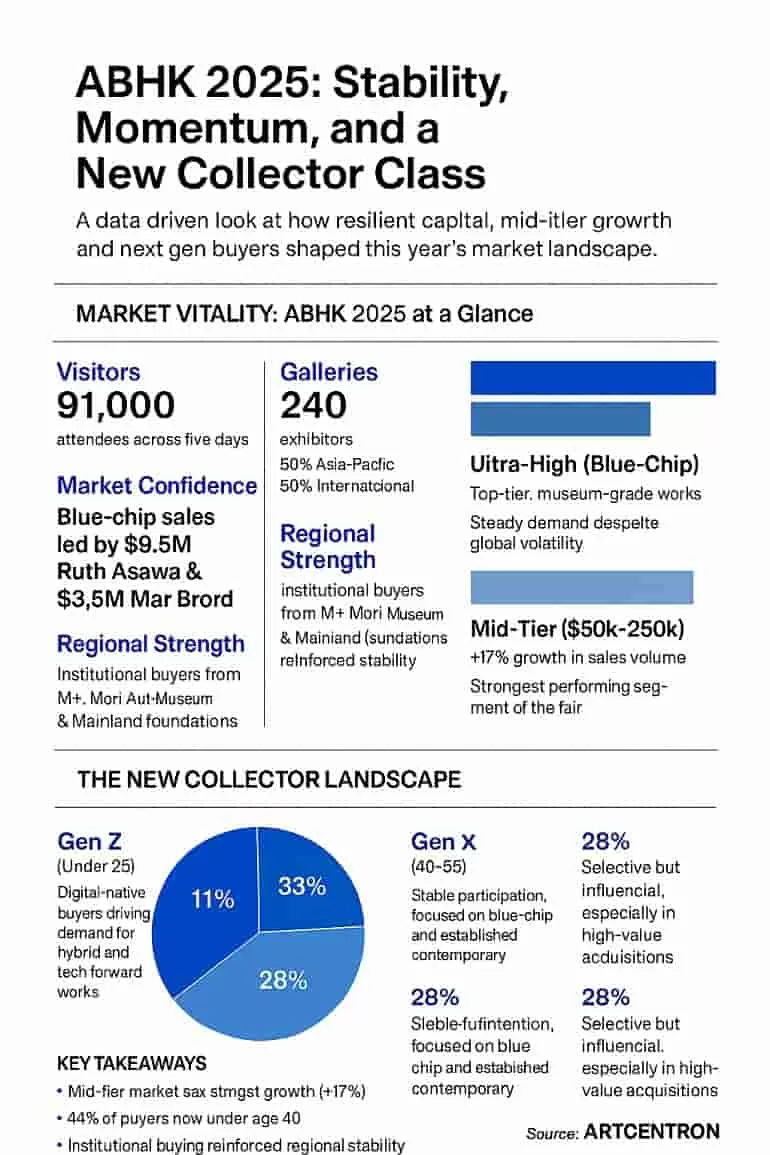
Capital Resilience: Despite global economic shifts, the “Hong Kong Premium” held steady. High-value transactions confirmed that liquidity continues to chase top-tier, museum-grade assets. Notable sales included a $9.5 million work by Ruth Asawa and a $3.5 million piece by Mark Bradford.
The Middle-Market Pivot: A 17% increase in sales was noted in the sub-$250,000 category. These results indicate that a broader base of entry-to mid-level collectors is sustaining overall market volume. At the same time, ultra-high-end megadeals have become more selective.
Demographic Shift: Millennials and Gen Z now account for nearly 44% of active buyers in the region. This collector base is shaping market demand in visible ways. Interest is rising in digital-hybrid works and in ultra-contemporary Asian artists.
Institutional Floor: Active purchasing by M+, the Mori Art Museum, and private Mainland foundations provided a critical “price floor,” ensuring long-term stability for regional artists highlighted during the fair.
Top 5 Artists to Watch: Post-ABHK 2025
- Shin Min (P21, Seoul): She is the winner of the inaugural MGM Discoveries Art Prize. Min is the definitive breakout star of the 2025 edition. Her booth, “EW! There Is Hair in the Food!,” captivated collectors with its raw, tactile exploration of domesticity and the body. With a $50,000 cash prize and upcoming exhibitions in Macau, her primary market value is poised for significant growth. Analysts expect a notable upward adjustment by late 2025.
- Li Hei Di (Pace Gallery/Various): Representing the “Ultra-Contemporary” surge, Li Hei Di’s work The Monstrosity Lies Between Us (2025) sold quickly for $50,000 to a private museum. Her fluid, oneiric paintings sit at the sweet spot of the middle market. Younger collectors continue to favor artists who blend traditional techniques with contemporary psychological themes. As a result, Li’s secondary market trajectory remains among the most promising in the region.
- Lu Yang (Various) A favorite among tech-savvy Millennials and Gen Z collectors, Lu Yang’s massive installation DOKU the Creator (2025) was a centerpiece of the Encounters sector. Lu Yang bridges the gap between high art, gaming, and digital identity in her works. This confluence of ideas makes them a “blue-chip” prospect of the digital age. Their work is a primary example of the “Digital-Hybrid” demand identified in our market insights.
- Pacita Abad (Silverlens/Tina Kim Gallery): While an established name, the 2025 fair marked a massive institutional “re-introduction” for the late Filipino-American artist. Southeast Asian and Greater China museums acquired multiple monumental paintings during the fair. Prices for major artworks hit the $500,000 mark. For collectors looking for “historical resilience,” Abad’s vibrant trapunto paintings are the way to go. They offer a proven track record backed by recent MoMA and Tate acquisitions.
- Ernie Wang (Linseed, Shanghai/Berlin) In the Discoveries sector, Ernie Wang’s ceramic installations—which cleverly conflate gym culture with religious ritual—achieved a complete sell-out. Priced in the accessible $10,000 to $25,000 range, Wang is a prime target for the “Next-Gen” collector base. His work represents the growing market appetite for multidisciplinary practices that offer high conceptual value at an entry-level price point.
Why These Artists Matter for the Art Business
These five names aren’t just selling well; they are defining the new standards of value in the Asian market.
- Shin Min and Ernie Wang prove that the “Discoveries” sector is a serious scouting ground for institutional-grade talent.
- Pacita Abad shows the enduring power of the secondary market when backed by fresh scholarship.
- Lu Yang and Li Hei Di signal the shift toward a more “fluid” and tech-integrated aesthetic that resonates with the 44% of buyers under age 40.
