ART NEWS
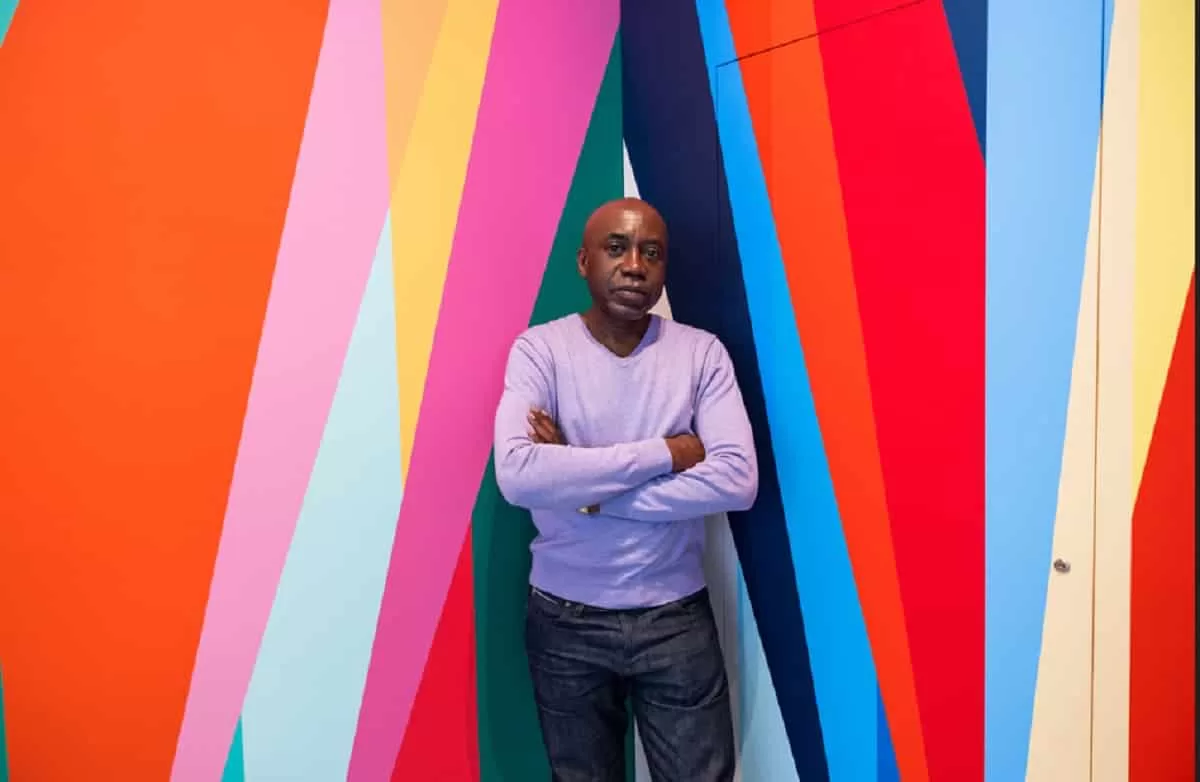
Inside the Odili Donald Odita lawsuit: Abstract painter sues Jack Shainman Gallery over $1.12M in withheld art. We break down the advance vs. stipend dispute.
BY KAZEEM ADELEKE, ARTCENTRON
NEW YORK, NY— The Odili Donald Odita lawsuit has quickly become one of the most scrutinized legal conflicts in the contemporary art world, casting a critical light on the fragile economics binding artists to galleries. What began in October 2025 as a simple disagreement over withheld artworks has now escalated into a sweeping dispute. It involves financial arrangements, contractual ambiguity, and the unraveling of a professional relationship that once appeared solid. As the case moves through New York’s Supreme Court, it offers a rare look at the tensions that ignite when trust, money, and artistic labor intersect.
Odita, acclaimed for his radiant geometric abstractions and recognized internationally, filed suit in October 2025. He alleges that Jack Shainman Gallery refused to return more than a dozen artworks valued at approximately $1.12 million. The lawsuit claims the gallery stopped paying the crucial monthly advance he had received since 2016. It also says the gallery provided limited clarity around sales figures and withheld work despite repeated requests for its return. According to the artist, once he reviewed the gallery’s accounting more carefully, he noticed discrepancies and concerns. These issues prompted him to seek greater control over his inventory.
Financial Claims Driving the Odili Donald Odita Lawsuit
The lawsuit centers on a financial arrangement that began nearly a decade earlier. In this agreement, the gallery provided a $14,000 monthly payment as an advance against future sales. Such agreements are common, but they often rely on trust rather than detailed, legally binding contracts. In late 2024, the gallery informed Odita that it could no longer support what it described as a large outstanding deficit. The monthly advance payment, which Odita viewed as a predictable stipend and essential for his financial stability, abruptly ended. The artist sought the return of his unsold works so he could sell them independently and address the alleged deficit. The gallery refused, even though the written agreement does not include a clause granting it the right to retain artworks in such circumstances.
The gallery’s counterclaims paint a fundamentally different picture. In its November 2025 filing, Jack Shainman Gallery rejects Odita’s allegations entirely, arguing that the artist—not the gallery—owes money. The gallery states emphatically that the monthly payment functioned strictly as a large advance that significantly expanded at Odita’s request. They claim they ultimately advanced him more than half a million dollars and describe the arrangement as increasingly unsustainable as sales began to slow.
Issues and Disagreements about Pricing
A particularly striking element in the gallery’s response concerns pricing. According to their filing, Odita pushed for his prices to rise by about 160 percent. This increase went far beyond the modest adjustment the gallery believed the market could bear. They argue that the steep escalation reduced demand and further complicated the financial relationship, making it difficult for the gallery to continue providing advances.
The dispute intensified around artworks originally consigned to David Kordansky Gallery, another space representing Odita. Jack Shainman Gallery contends it had the right to retain these pieces until repayment of outstanding advances. Although the works were eventually returned to Odita, the gallery maintains that he still owes nearly $300,000. This claim reinforces their argument that the lawsuit is an attempt to avoid repayment rather than a genuine dispute over withheld art.
The Legal Precedent Art as Collateral
The entire Odili Donald Odita lawsuit hinges on a major legal unknown. The issue is whether a gallery may keep an artist’s work as de facto collateral when a contract does not explicitly grant that right. In many jurisdictions, artists retain legal ownership over their unsold work, and galleries function as fiduciaries, not creditors. If the court finds that the gallery exceeded its authority in retaining Odita’s inventory, the case could set a vital precedent for artists navigating complex consignment relationships.
The timing of the dispute has also drawn attention. Jack Shainman Gallery recently expanded into a monumental new Tribeca space. Such expansions demand considerable capital, leading some observers to wonder whether broader financial pressures intersect with the gallery’s dealings with its artists. This dispute underscores the financial complexities galleries increasingly face.
The emotional dimension of the breakdown between Odita and Jack Shainman Gallery cannot be ignored. For years, mutual admiration marked the relationship. Gallery representatives say they were close to reaching an agreement before the lawsuit was filed. They describe the swift legal action as unexpected and disheartening. From the artist’s perspective, the collapse of trust appears to have been gradual. He links it to concerns about transparency, withheld funds, and limited access to his own work.
Whatever the motivations on each side, the lawsuit has already prompted broader industry reflection. The contention highlights how vulnerable artists can be when advances are governed by informal agreements. At the same time, the case illustrates the financial risks galleries take when they offer substantial support to artists in a volatile market. As more artists seek global representation, the need for clear expectations around inventory, pricing, and financial responsibilities has become even more urgent.
Key Takeaways from the Odili Donald Odita Lawsuit
As the Odili Donald Odita lawsuit proceeds, it may result in a private settlement or a court-ordered financial accounting. The ruling could also clarify precisely how consigned artworks may—or may not—be treated in cases of disputed debt. Any outcome would reverberate through the art world. It would influence how artists and galleries construct their agreements and how they interpret the obligations that underpin their partnerships.
At its core, the case reflects the unraveling of a relationship built on creative collaboration and trust. Its resolution—whether achieved through negotiation or legal judgment—will likely shape future conversations about transparency, responsibility, and the financial structures that support contemporary art.
Featured image: Odili Donald Odita in front of ARCH-13592. Image courtesy of David Kordansky Gallery
What do you think about the Odili Donald Odita lawsuit? What is the impact on galleries? Share your thoughts. Leave a comment
